
Effective and Painless Laser Hair Removal Solutions

We’re sure you’re tired of continuous visits to the salon for painfull and pesky waxing sessions. Bid a permanent adieu to those pesky and unwanted body hair with our advanced Laser Hair Removal Procedures. Having a success rate of over 99%, we use the latest technologies to give you that smooth, hairless skin permanently!
Apart from international standard technologies, our experts are thoroughly trained to make sure even the lightest hair is not left untreated.
What is Laser Hair Removal?
Laser hair removal is a medical grade laser treatment, which is designed to target and destroy hair follicles. The laser is searching for melanin (dark pigment) within the hair. Hair uptake of light causes it to heat which can affect the root and prevent easy regrowth.
Imagine it is like this:
Waxing removes hair only from the root, which causes painful pulling sensation.
Damage to the root caused by laser results in a decrease in growth, a delay in growth or no growth.
The key to laser: it's not going to work on every hair simultaneously. There are three phases in hair growth. Laser will only affect growing hair (anagen). That is why it is necessary to have several sessions.
In India, the laser machines are of various types.
This is the most confusing aspect for customers. There are different types of lasers that operate on different skin and hair types. The right laser will burn or yield no results.
1. Diode Laser
- How it works: It involves a single wavelength (800-810 nm) which is able to penetrate deeply enough into the skin.
- Best use: For Indian skin tones (Fitzpatrick III-V). Works on thick, dark hair.
- Pain level: Moderate. The majority of machines have a cooling tip.
- Popularity in Delhi: Safe for wheatish to dusky skin. Good balance of effectiveness and safety.
- Sessions needed: 6–8
2. Nd:YAG Laser
- How it works: It uses a longer wavelength (1064 nm) which penetrates the surface of the skin and can be directed deeper into the follicle.
- Ideal for: Dark skin (Fitzpatrick V and VI). Also works on tanned skin.
- Safety: Lower risk to skin layer than diode, as it does not affect the top skin layer.
- Important: Many clinics in Delhi have adopted this when the patients have very dark complexion or when they are in the sun for a long time.
- Sessions needed: 6–10 sessions (more than diode)
3. Alexandrite Laser
- Working principle: It uses a short wavelength (755 nm). Very powerful but superficial.
- Best suited for: Fair to light brown skin (Fitzpatrick I–III).
- Pain level: High. Feels like strong snaps.
- Warning: Not suitable for average Indian dusky or dark complexion. Burns are a possibility.
- Sessions needed: Minimum 4 sessions (best results up to 6)
4. IPL (Intense Pulsed Light)
- How it works: NOT a laser. A wide range of light, similar to powerful camera light.
- Ideal for: Extremely light hair and very fair skin.
- Pain: Low to mild.
- Truth: Beauty parlours refer to this as "laser," but it is not. IPL is much weaker. Thick Indian hair doesn't work well.
- Sessions needed: 10-12+ and results are often unsatisfactory.
Pro tip for Delhi folks: "Diode, Nd:YAG, Alexandrite, ya IPL?" Anything other than IPL for your legs or underarms is not it – find another clinic.
How Laser Hair Removal actually functions (Step-by-Step)
Before the treatment (prep)
- The area is shaved 24 hours prior. Hair should not show through the skin, but just below.
- Waxing, plucking or threading must not be done for 4 weeks prior. The root needs to be untouched.
- No sun or tanning for 2 weeks. Sunburn / skin tanning can burn.
During the treatment
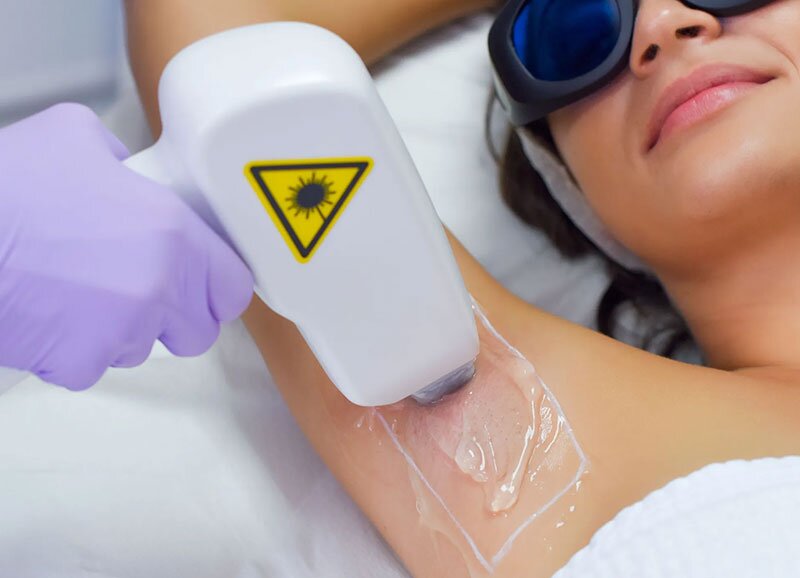
- Dark goggles help to keep your eyes safe from harm.
- Cooling gel is applied (occasionally) by the technician.
- A device held in the hand is pressed against the skin.
- A flash of light is emitted. You experience the sensation of a rubber band snapping.
- Upper lip (small area): 2-3 minutes. Large areas (full legs): 30-40 minutes.
Following the treatment (immediate)
- Skin may be warm and slightly red for 1-24 hours.
- Burnt hair odor may occur. This is normal — the hair shaft is burning.
- In 5–14 days, treated hair will fall out on its own. Do not pull them.
Between sessions
- Avoid waxing or plucking. Shaving is allowed.
- Avoid sun completely. Apply sunscreen (SPF 50+) every day – even during winters in Delhi.
- After each session, hair will regrow thinner and patchier. It's working!
How do lasers work?
Laser technologies emit beams of highly concentrated light into hair follicles which is absorbed by the pigment in the hair follicles, thus destroying it. This is why lasers are the only solution to get rid of body hair, permanently.
At Dermalyn, a Combination of two wavelengths is used to treat fine hair, resistant hair, light colored hair and PCOs-related growth too. The technologies that we use offer effective hair removal procedure that is completely pain-free and has no side effects.
Furthermore, we analyze each and every session of our clients to customize each session according to your skin needs. Everyone is different and everyone’s skin is different, hence, the protocols for each individual should be differently customized according to the patient’s skin and hair type.
How many sessions are really needed?
This will depend on your hormones and body area. For a realistic approach:
| Body Area | Sessions Needed | Gap between sessions |
|---|---|---|
| Upper lip / Chin | 6–8 | 4 weeks |
| Underarms | 6–8 | 4–5 weeks |
| Arms | 6–8 | 5–6 weeks |
| Legs | 6–8 | 6–8 weeks |
| Bikini / Brazilian | 8–10 | 6 weeks |
| Chest / Back (men) | 8–12 | 6–8 weeks |
Why is there the need for so many sessions?
Hair follicles don't grow continuously. Only 20-30% of hairs are in the growth phase at any one time. The same area needs to be treated more than once to ensure that all follicles are caught when they are growing.
After completing full sessions: Most people require 1-2 touch up applications annually. New hair growth can occur due to hormonal fluctuations (such as pregnancy, PCOS and menopause).
Who is a good candidate? (Honest Answer)
Excellent candidate
- Dark brown or black hair
- Fair to medium skin tone (not tanned)
- No hormonal disorders
- Realistic expectations (reduction, not zero)
Good candidate (with right laser)
- Brown or black hair on dark skin
- Wheatish to dusky skin (Fitzpatrick IV-V)
- Using Nd:YAG or Diode laser
Poor candidate (low results or unsafe)
- White, grey, red or blonde hair (no melanin for the laser to target)
- Fitzpatrick VI: Very dark skin (without Nd:YAG)
- Rash or infected skin area in treatment zone
- Pregnancy (no safety data, most clinics do not accept)
- Taking photosensitizing medications (some antibiotics, acne treatments)
Real benefits (what you will notice)
| Benefit | What it means |
|---|---|
| 70-90% hair reduction | After 6-8 sessions, majority of hair is gone. Remaining hair is light and thin. |
| No ingrown hairs | Laser destroys the root. Curls do not grow back into the skin. Great for bikini and underarms. |
| Longer breaks between sessions | Once full course is taken, you can shave once a month rather than every 2 days. |
| Softer regrowth | Fine growth like peach fuzz regrows — not thick stubble. |
| Money saved | No monthly waxing appointments. No daily shaving. |
Risks & Side Effects (Honest, No Hiding)
Common (temporary)
- Redness and swelling (few hours to 2 days)
- Mild burning sensation
- Hair that looks longer, but is actually pushing out dead hair
Less common but possible
| Side Effect | Description |
|---|---|
| Burns or blisters | If technician uses wrong laser or settings for the skin |
| Hyperpigmentation | Dark spots in treated area. Typically disappears in months. |
| Hypopigmentation | White spots. Uncommon and in some instances permanent. |
| Paradoxical hypertrichosis | Laser stimulates MORE hair growth. Rare; reported on face and neck. |
How to reduce risks
- Always do a patch test on a small area first.
- Wait 24-48 hours to observe effects on your skin.
- Choose a clinic that has a doctor, NOT just a beautician.
- Do not use IPL devices for thick or large hair areas.
What Affects Results?
| Factor | Explanation |
|---|---|
| Hair color & thickness | Dark thick hair is best. Light, thin or vellus hair (peach fuzz) gives poor results. |
| Skin color | More contrast between hair and skin = better results. Low contrast (dark skin + dark hair) = difficult, but possible with Nd:YAG. |
| Hormones | PCOS, thyroid issues, pregnancy cause persistent regrowth. Laser helps but rarely clears entirely. |
| Technician skill | Bad settings = burns or no results. Right settings = effective and safe. |
| Consistency | Not attending sessions or spacing them too far apart = less successful outcomes. |