

What Is Root Restore Therapy (RRT)? The Hair Treatment Nobody’s Talking About
June 22, 2026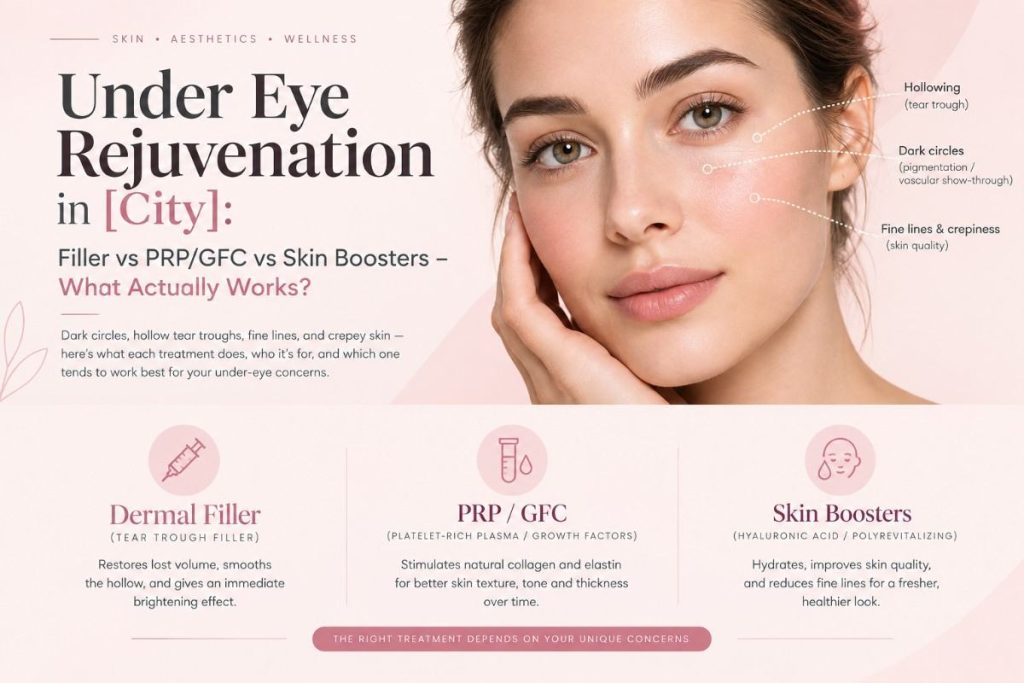
Dark circles, hollow tear troughs, crepey skin, fine lines — the under-eye area is often the first place that shows fatigue, genetics, and age, and it’s usually the last place people know how to fix. Walk into any clinic in Delhi today and you’ll be offered at least three very different-sounding forms of Under Eye Rejuvenation: dermal fillers, PRP (or its newer cousin GFC), and skin boosters. All three promise “brighter, fresher eyes.” Very few clinics actually explain why one might work for you and the other might make things worse.
This guide breaks down what each treatment actually does at a tissue level, who it’s designed for, what results (and risks) to realistically expect, and — most importantly — a practical ranking of what tends to work best for which under-eye concern. This isn’t a sales pitch for one modality; it’s a decision-making framework, because under-eye rejuvenation is one of the few areas of aesthetic medicine where the “trendiest” option is frequently not the correct one for a given face.
Why the Under-Eye Area Ages Differently
Before comparing treatments, it helps to understand why the under-eye region behaves so differently from the rest of the face — and why Under Eye Rejuvenation needs a different approach than the rest of a facial treatment plan.
The skin under the eyes is among the thinnest on the entire body — roughly half the thickness of skin elsewhere on the face — and it has very little underlying fat or muscle support. This means it shows three distinct problems, often at the same time, and each responds to a different type of treatment:
- Volume loss (tear trough hollowing): As the deep fat pads under the eyes shrink and the orbital bone remodels with age, a visible hollow or groove forms between the lower eyelid and the cheek. This creates a shadow that reads as a “dark circle” even when pigmentation isn’t the actual cause.
- Skin quality decline (texture, crepiness, fine lines): Because the skin here is so thin and collagen-poor to begin with, it’s usually the first area to show crepey texture, fine lines, and dullness — independent of volume loss.
- Pigmentation and vascular show-through: Thin skin means the bluish tint of underlying blood vessels or excess melanin becomes more visible, contributing to the “tired” look.
Nearly every under-eye consultation someone books in [City] is actually a mix of these three problems in different proportions — which is exactly why one treatment rarely solves everything, and why practitioners who only offer one modality tend to over-prescribe it. A well-planned Under Eye Rejuvenation strategy starts by identifying which of these three problems is actually driving your concern, not by picking a treatment first.
Treatment 1: Dermal Filler (Tear Trough Filler)
Tear trough filler remains one of the most requested forms of Under Eye Rejuvenation in [City] — almost always hyaluronic acid (HA) based, it’s injected into the hollow beneath the eye to physically restore lost volume and smooth the transition between the lower lid and cheek.
How it works: A soft, low-density HA filler is placed either just above the bone (supraperiosteal) or in a more superficial plane, depending on the depth of the hollow. The gel binds water and adds structural volume, essentially filling in the groove from underneath.
Best for: True structural hollowing — the kind where you can see or feel an actual indentation, not just discoloration. It’s the fastest, most visible fix for volume-related dark circles and is often the only treatment of the three that produces an immediate, dramatic “before and after.”
What it doesn’t fix: Filler does not improve skin texture, fine lines, or crepiness. In fact, using filler on someone whose main issue is skin quality (not volume) is one of the most common over-treatment mistakes in aesthetic medicine — it can create a puffy, unnatural look known as the “tear trough bulge” or contribute to the so-called “filler face” if overdone or placed too superficially.
Downtime and risks: Bruising and swelling for 3–7 days is common. The under-eye area is also one of the more technically demanding injection sites — poor technique carries a small but real risk of the Tyndall effect (a bluish discoloration from filler sitting too close to the surface), lumping, or in very rare cases, vascular complications. This is a treatment where practitioner experience matters more than the product used.
Longevity: Typically 9–18 months, depending on the filler type and individual metabolism.
Treatment 2: PRP (Platelet-Rich Plasma)
PRP is one of the most established blood-based approaches to Under Eye Rejuvenation. It involves drawing a small amount of the patient’s own blood, spinning it in a centrifuge to concentrate the platelets, and injecting (or micro-needling) that plasma back into the under-eye skin.
How it works: Platelets release growth factors that stimulate the body’s own collagen and elastin production, gradually improving skin thickness, tone, and texture over several weeks. It doesn’t add volume the way filler does — it works by regenerating the patient’s own tissue.
Best for: Mild-to-moderate skin quality concerns — thin, crepey, dull under-eye skin without significant hollowing. It’s also a popular choice for patients who specifically want a “natural” treatment using their own biological material rather than an injectable product.
What it doesn’t fix: PRP will not correct a true structural hollow. Expecting PRP to erase a deep tear trough is one of the most common reasons patients feel “it didn’t work” — the treatment was simply mismatched to the problem.
Downtime and risks: Minimal — some redness, swelling, and mild bruising from the needling or injection points that typically resolves within 2–4 days. Because it uses the patient’s own blood, allergic reaction risk is essentially eliminated, which is a genuine advantage for sensitive-skin patients.
Longevity and course: PRP is rarely a one-and-done treatment. Most protocols call for 3 sessions spaced 3–4 weeks apart, with visible improvement building gradually over 2–3 months and maintenance sessions every 6–12 months.
Treatment 3: GFC (Growth Factor Concentrate)
GFC is a newer, related-but-distinct approach to Under Eye Rejuvenation that’s gained significant traction in Indian aesthetic clinics over the last few years, and it’s frequently confused with PRP.
How it works: Where PRP concentrates platelets, GFC uses a specialized process to lyse (break open) those platelets and isolate a purified concentrate of the growth factors themselves — without the platelet membranes, white blood cells, or other components that come along in standard PRP. The result is a more concentrated, more consistent growth-factor dose per session.
Best for: The same category as PRP — skin quality, texture, and mild pigmentation concerns — but many practitioners report GFC delivers more consistent and slightly faster results, with less of the swelling that can come from the platelet aggregation in whole PRP. It’s increasingly the preferred option for patients who found PRP results underwhelming or inconsistent.
What it doesn’t fix: Same limitation as PRP — it’s a regenerative, not a volumizing, treatment. It will not fill a genuine tear trough hollow.
Downtime and risks: Similar to or slightly milder than PRP — minimal downtime, very low complication risk since it’s also autologous (from the patient’s own blood).
Longevity and course: Typically 3–4 sessions initially, 3 weeks apart, with results building over 6–8 weeks and touch-ups every 6–9 months.
Treatment 4: Skin Boosters
Skin boosters offer a fourth route to Under Eye Rejuvenation. Formulations like Profhilo, Rejuran, and Redensity are injectable treatments distinct from both traditional filler and PRP/GFC — they sit in a category of their own, sometimes called “bio-remodelers.”
How it works: Unlike traditional dermal filler, skin boosters use a much lower-density, highly hydrating form of HA (or, in the case of Rejuran, polynucleotides derived from salmon DNA) that spreads through the tissue rather than sitting as a discrete volumizing bolus. The goal isn’t to physically fill a hollow — it’s to hydrate the skin from within and stimulate a slow, steady collagen response over weeks.
Best for: Crepey texture, fine lines, dehydration, and dullness — essentially the same skin-quality concerns as PRP/GFC, but delivered via a manufactured, standardized product rather than the patient’s own blood. Many practitioners consider skin boosters the more “reliable” option compared to PRP because the growth-factor concentration in PRP naturally varies from person to person, while a boosted product is dosed consistently every time.
What it doesn’t fix: Like PRP and GFC, skin boosters do not address structural volume loss.
Downtime and risks: Small injection-point bumps that settle within 24–48 hours; minor bruising is possible. Because these are manufactured products rather than autologous blood, there’s a small allergic/inflammatory reaction risk, though it’s low with reputable, CE/FDA-cleared products.
Longevity: Results typically build over 4–8 weeks and last 6–12 months, with maintenance sessions recommended roughly every 6 months.
Side-by-Side Comparison
Here’s how the four main Under Eye Rejuvenation options stack up against each other:
| Dermal Filler | PRP | GFC | Skin Boosters | |
|---|---|---|---|---|
| Primary action | Adds volume | Regenerates tissue | Regenerates tissue (concentrated) | Hydrates + remodels |
| Best for | Structural hollowing | Mild skin quality issues | Skin quality, more consistent results | Texture, dehydration, fine lines |
| Speed of visible result | Immediate | Gradual (4–8 weeks) | Gradual (4–6 weeks) | Gradual (4–8 weeks) |
| Sessions typically needed | 1 (touch-up as needed) | 3, then maintenance | 3–4, then maintenance | 2–3, then maintenance |
| Downtime | Moderate (bruising 3–7 days) | Low | Low | Low |
| Longevity | 9–18 months | 6–12 months | 6–9 months | 6–12 months |
| Fixes hollowing? | Yes | No | No | No |
| Fixes texture/crepiness? | No | Yes | Yes | Yes (often the strongest) |
| Allergy risk | Low (HA-based) | Essentially none (autologous) | Essentially none (autologous) | Low but present (manufactured product) |
So What Actually Works? The Realistic Ranking for Under Eye Rejuvenation
There’s no single “winner” here — the honest answer depends entirely on which of the three underlying problems (volume, texture, or pigmentation/vascularity) is driving the concern. That said, based on how these treatments actually perform in practice:
1. For genuine hollowing / structural dark circles → Filler wins, clearly. Nothing else on this list adds physical volume. If a finger pressed gently under the eye reveals an obvious indentation, filler is the only treatment that will produce a visible transformation, and it will do so in a single session.
2. For crepey, thin, dull under-eye skin with no real hollow → Skin boosters or GFC, roughly tied. Skin boosters have the edge on consistency (standardized dosing every time), while GFC has the edge for patients who prefer an autologous, product-free approach. Both meaningfully outperform standard PRP for this specific concern.
3. For patients wanting a “natural,” blood-derived option and willing to commit to a multi-session course → GFC over PRP. GFC’s purified, concentrated growth-factor delivery is increasingly replacing standard PRP in under-eye protocols because it tends to produce more predictable results with less swelling.
4. For combination cases (most real patients) → A staged, combined approach outperforms any single treatment. The most consistently good outcomes come from correcting volume first with a conservative filler placement, then layering skin boosters or GFC on top over subsequent sessions to address the surface quality that filler alone can’t touch. Clinics that push one modality as a universal fix for every under-eye concern are usually optimizing for simplicity, not for the patient’s actual anatomy.
5. What consistently underperforms → PRP used alone for hollowing, and filler used alone for pure texture concerns. These are the two most common mismatches seen in under-eye consultations, and they’re the primary reason patients report disappointing results from otherwise legitimate treatments.
Choosing a Practitioner in Delhi
Because the under-eye area is thin, vascular, and unforgiving of poor technique, the single biggest variable in outcome isn’t the treatment chosen — it’s who’s holding the needle. When evaluating clinics in Delhi for under-eye rejuvenation, a few questions are worth asking directly:
- Does the practitioner perform an actual assessment of hollowing vs. skin quality vs. pigmentation before recommending a treatment, or do they default to whatever they sell most often?
- For filler specifically: what product and injection depth do they use for the tear trough, and how many years of experience do they have with this specific area (not just facial filler broadly)?
- For PRP/GFC: is the preparation done in-house with a proper centrifuge/kit system, and how many sessions does their protocol actually recommend?
- Are before-and-after photos from their own patients available, ideally at the 2–3 month mark rather than immediately post-treatment (which can look artificially good due to temporary swelling)?
Frequently Asked Questions
Can filler and PRP/GFC or skin boosters be combined in the same treatment plan?
Yes — this is increasingly the preferred protocol for patients with both volume loss and poor skin quality. Filler is typically done first to correct structure, with regenerative treatments layered in afterward (often a few weeks apart) to improve the overlying skin.
Which option has the least downtime?
PRP, GFC, and skin boosters all have relatively minimal downtime compared to filler, which carries a higher chance of visible bruising for several days.
Is PRP/GFC a permanent fix?
No treatment on this list is permanent. PRP and GFC require an initial course of sessions followed by periodic maintenance, generally every 6–9 months, to sustain results.
Why did my filler make my dark circles look worse?
This usually happens when filler is used on skin quality issues (thin, translucent, or pigmented skin) rather than true volume loss, or when it’s placed too superficially — both can create a puffy or bluish look rather than the intended smoothing effect.
How do I know if my dark circles are from volume loss or pigmentation?
A simple way to check: gently stretch the skin under the eye. If the darkness lightens noticeably, pigmentation or thin skin is likely the primary factor. If a visible groove or hollow remains regardless, volume loss is the bigger contributor — and a consultation that includes this kind of assessment is a good sign of a practitioner who’s matching treatment to cause rather than defaulting to one method.